Meet the What If Part-Time Cohort 2
We're excited to introduce cohort 2 of the Cambridge NeuroWorks What If Part-Time Programme!
These innovators are exploring bold neurotechnology ideas to address unmet needs in neurological conditions and improve brain health.
Through virtual sessions, peer-to-peer learning, and in-person unconferences across the UK, they'll refine their hypotheses and connect with experts in the neurotech ecosystem.
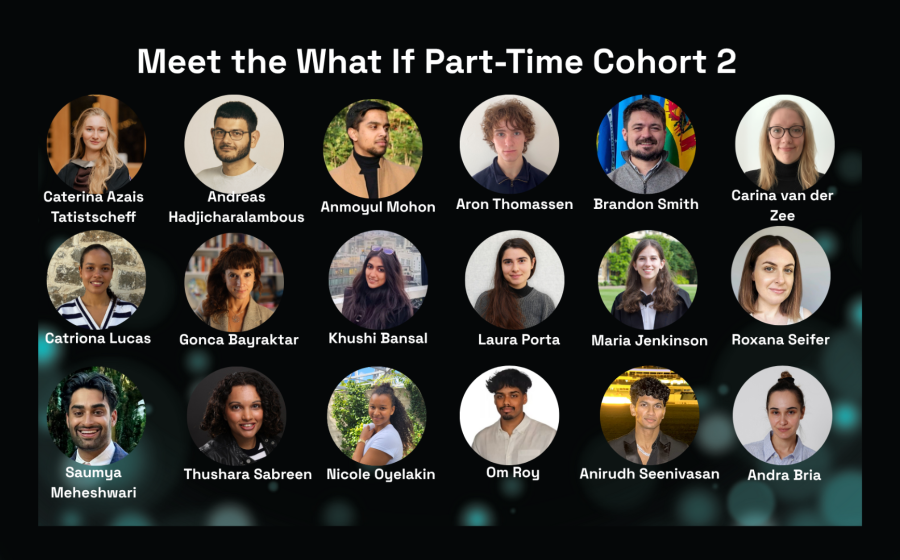
Caterina Azais Tatistscheff – Cate is a biomedical engineer on a mission to unlock the brain. Current imaging tools fail us—over 80% of the brain remains invisible. What if we had sensors so small they required no surgery, yet delivered signals as clear as today’s most invasive methods? Cate’s vision is to translate brain imaging from the lab to every clinic: fast, affordable, scalable, and at cellular precision.
Andreas Hadjicharalambous – Andreas is a Senior Protein Engineer with a combined 10 years' experience in biochemistry and protein engineering, in both academia and the Oxbridge Biotech scene. He aims to develop an immunotherapy that reprograms the brain’s immune system to fight Alzheimer’s disease, a devastating condition with an expanding unmet clinical need.
Anmoyul Mohon – Anmoyul is currently a Wellcome Trust Immuno-Matrix in Complex Disease (ICD) PhD student at the University of Manchester, combining matrix biology and neuroimmunology in CNS autoimmunity and parasitic infection. He has experience in Pharma & Life Sciences Consulting Intern at Nexcea and is interested in the intersection of life sciences, finance, and strategy, including consulting, investment (VC and PE), and corporate finance.
Aron Thomassen - His project explores how a wearable EEG and AI could be used to create a reliable, user-friendly tool for seizure detection, in order to ease the uncertainty faced by carers and family by providing more reliable data to improve clinical decision-making. His personal experience of caring for his sister, who has epilepsy, has inspired him to find solutions that bridge everyday needs with clinical practice.
Brandon G. Smith, PhD - Brandon is developing a scalable infrastructure that enhances existing neuromonitoring technologies to capture and unify ephemeral physiological data that would otherwise be lost. The platform enables local processing and real-time insights, supporting a shift toward predictive, personalised, preemptive care.
Carina van der Zee - Carina co-founded JawSense to pioneer neuroscience-driven solutions for sleep bruxism, repositioning a condition affecting millions from a dental issue to a treatable neurological disorder. The company's patented device integrates biosensors and real-time AI to target underlying brain pathways through closed-loop neurostimulation.
Catriona Lucas - Catriona is exploring AI-guided neurosurgical interventions. These minimally invasive, scalable implants will use on-device neuromorphic chips to forecast neural crises and deploy plug-and-play chemical, electrical, or ultrasound modules for circuit-specific therapy.
Dr. Gonca Bayraktar - Gonca is a translational neuroscientist who is focused on developing therapeutic interventions and diagnostic tools for neurodegenerative diseases. Gonca aims to develop an audio-based diagnostic solution for early-stage dementia.
Khushi Bansal - A physics student at Imperial, Khushi is developing a machine learning model using wearable data to improve early diagnosis and care for Progressive Supranuclear Palsy (PSP), a rare condition, often mistaken for Parkinson’s.
Laura Porta - A research software engineer at the Sainsbury Wellcome Centre, Laura designs neural data tools and is building a shared framework that integrates open neuroscience datasets to generate predictive models and reduce animal testing.
María Jenkinson Álvarez - María works on early-stage commercialisation at the MRC and has previous experience in technology transfer, venture building, and strategic and research roles within start-ups and academia. Her What If goal is to develop scalable, non-invasive technologies to prevent or reverse inflammation-driven immune dysfunction.
Roxana Seifer - Roxana is exploring preventative brain health solutions, leveraging neuroscience and technology to enable a more human-centred future of work.
Saumya Maheshwari - An academic clinician with research interests in neuromodulation. Saumya is keen to develop scalable approaches for how we modulate, monitor and deliver advanced therapies in neurological disease.
Thushara Sabreen - With experience in design, product development and innovation, Thushara is developing patented smart footwear that delivers adaptive touch therapy to support autonomic balance, stress recovery, sleep, and resilience.
Nicole Oyelakin - Nicole is in her second year of biomedical engineering and has always loved neuroscience and biotechnology. Her idea revolves around making a pain-relieving device.
Om Roy - Om is developing a neuroscience AI platform that uses machine learning to enable non-invasive diagnosis and treatment of neurological disorders through a closed-loop neuromodulation device.
Anirudh Seenivasan - An Imperial College student, exploring the early detection of protein aggregates, followed by low frequency ultrasound to manipulate natural clearance. If the harmful protein clumps can be flushed out before neurodegenerative symptoms appear, it may be possible to preserve normal brain function.
Andra Bria - Andra is investigating how menstrual blood-derived stem cells and organ-on-chip technology can treat neurodegeneration and fertility issues in women, through ethical, community-centred science.
Stay up to date with progress over on Connect: Health Tech.